Secondary structure optimisation (DERNA)
Table of contents
Overview
The Secondary structure optimisation strategy in mRNArchitect uses the DERNA algorithm (Gu et al., 2024), which returns Pareto-optimal solutions that simultaneously optimise the minimum free energy (MFE) and the codon adaptation index (CAI) of the coding sequence.
If you only want to optimise for CAI, use the Codon optimisation and manufacturability (DNA Chisel) strategy instead.
Implementation details
- DERNA version: mRNArchitect uses DERNA v1.0.4 (the latest release available during development of mRNArchitect v2.0.0), with a patch that updates the default (human) codon frequencies to match the Kazusa database.
- Folding model and mode: DERNA is run with the Zuker & Stiegler folding model in MFE + CAI mode (Gu et al., 2024).
- MFE re-calculation: DERNA reports slightly different MFE values from ViennaRNA. For consistency with codon optimised mRNA sequences, mRNArchitect re-calculates the MFE and the secondary structure (in dot-bracket notation) of the optimised sequence using the ViennaRNA package (Lorenz et al., 2011).
DERNA is computationally intensive. To keep run times practical, this strategy is only available for protein sequences of 300 amino acids or fewer.
How to use
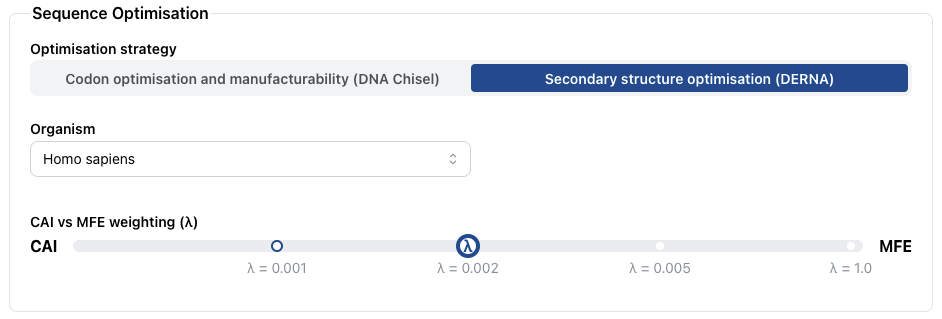
The secondary structure optimisation strategy allows users to specify two parameters:
| Parameter | Description |
|---|---|
| Organism | mRNArchitect loads the codon usage table for any organism listed in the Kazusa database. This table specifies the optimal codons for use in sequence pareto-optimisation. |
| Lambda (λ) | Controls the trade-off between CAI and MFE for use in sequence optimisation. Use the slider to select a value. |
Choosing a lambda value
mRNArchitect offers four lambda values: 0.001, 0.002, 0.005 and 1.0. They were chosen based on benchmarking, so that together they cover the range of the Pareto front between the highest-CAI and lowest-MFE solutions.
λ = 0.002 lies approximately at the midpoint between the highest CAI and the lowest MFE on the Pareto curve, and is a good starting point if you are unsure.
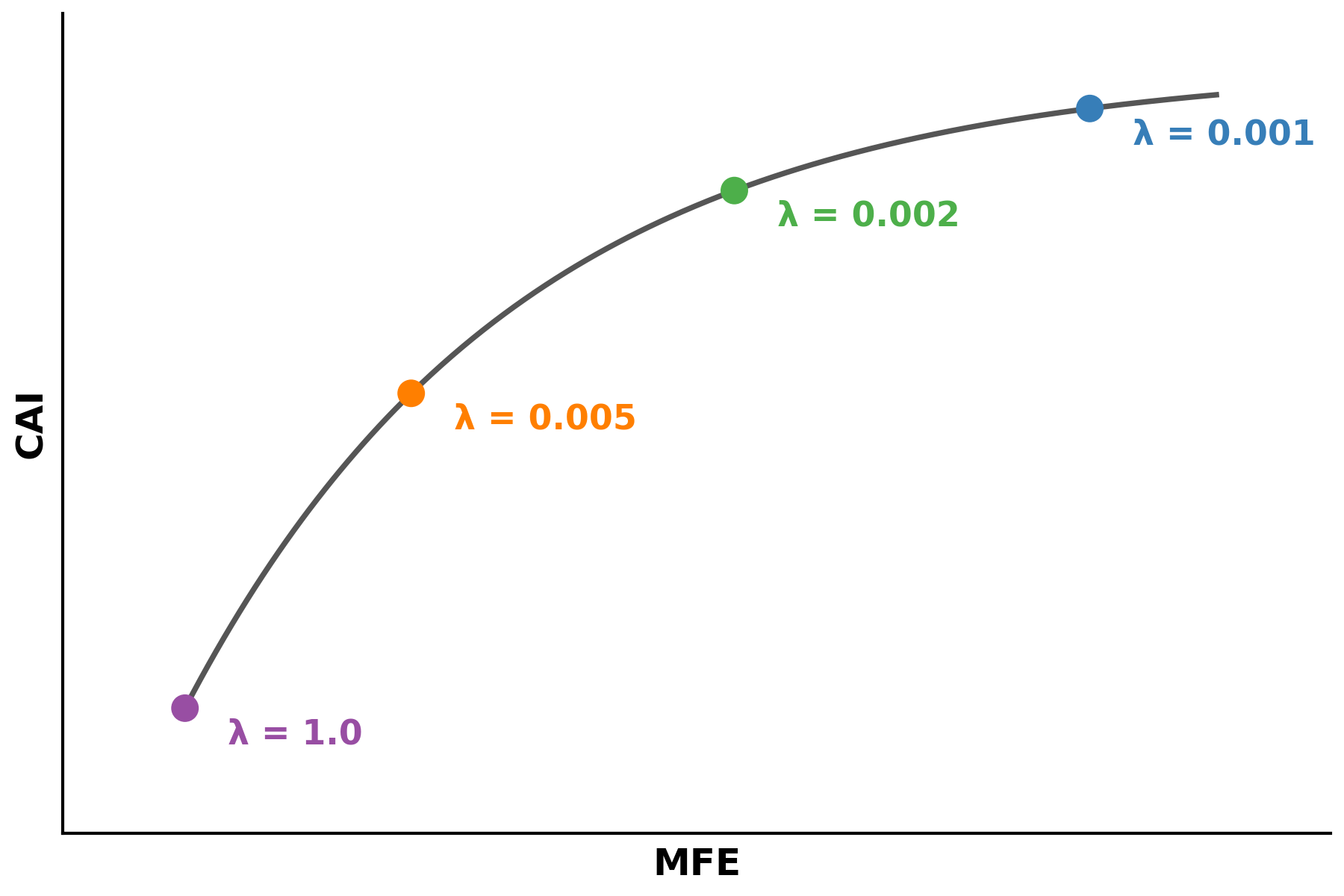 Pareto front of CAI versus MFE with the four selectable lambda values marked.
References
Gu, X., Qi, Y., & El-Kebir, M. (2024). DERNA enables Pareto optimal RNA design. Journal of Computational Biology, 31(3), 179-196. https://doi.org/10.1089/cmb.2023.0283
Lorenz, R., Bernhart, S. H., Höner zu Siederdissen, C., Tafer, H., Flamm, C., Stadler, P. F., & Hofacker, I. L. (2011). ViennaRNA Package 2.0. Algorithms for Molecular Biology, 6(1), 26. https://doi.org/10.1186/1748-7188-6-26